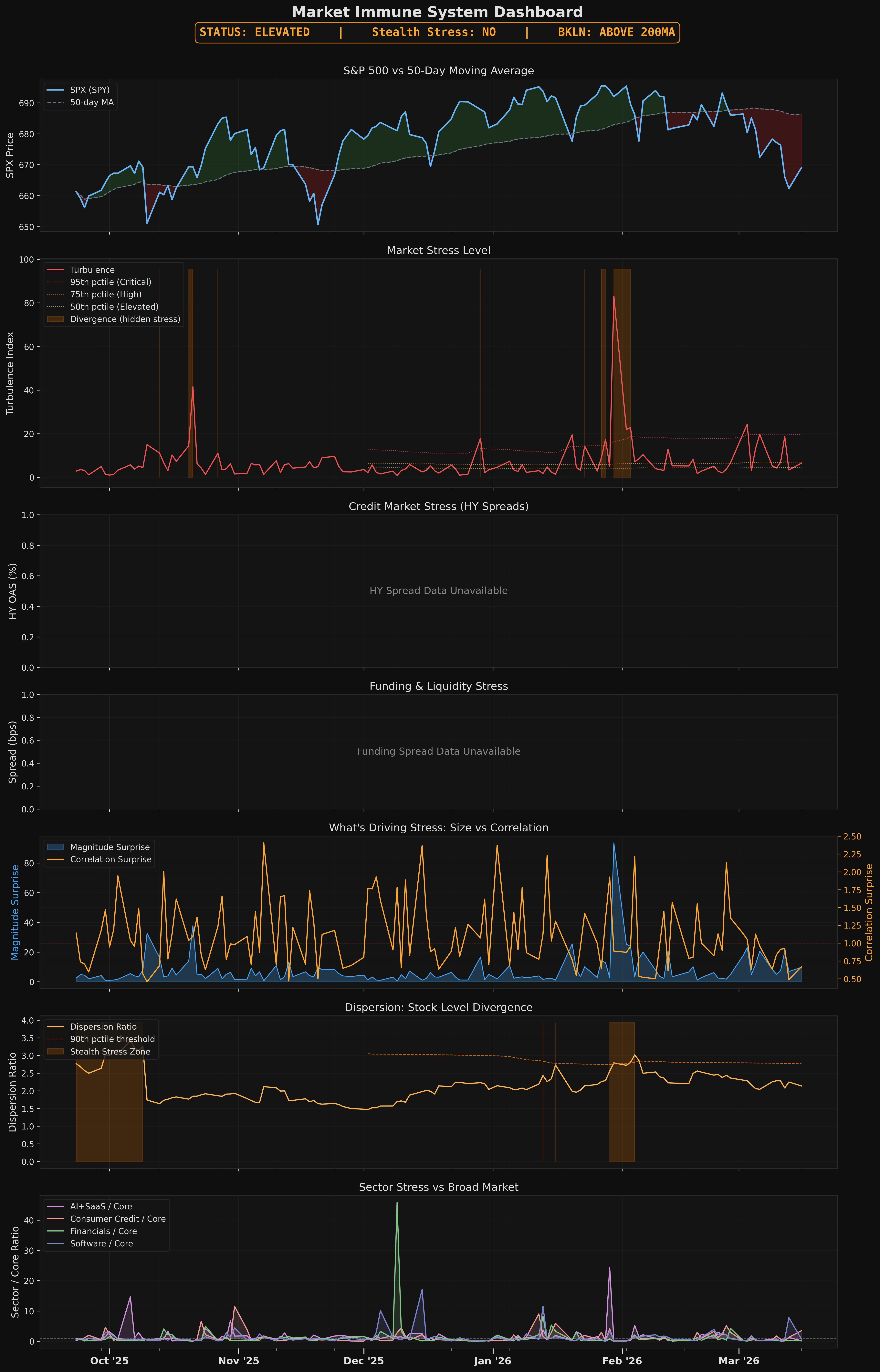
Immune System
STATUS: ELEVATED
Cross-asset turbulence is moderately above normal. This describes the current regime -- it does not predict forward drawdowns. Higher turbulence often coincides with market troughs, not onsets.
What does this mean?
The market is showing some mild stress — like a low-grade fever. Different investments are moving in slightly unusual ways compared to recent history. This doesn't predict a crash — in fact, mild stress often appears near the bottom of dips, not the start. Keep an eye on things, but no need to panic.
What's Driving It
- [CURRENT STATE] ● Turbulence ELEVATED -- cross-asset stress above normal Measures how many different investments are moving in unusual ways at the same time — like a fever thermometer for the whole market
- [CURRENT STATE] ○ Dispersion NORMAL -- names moving in line with the index Tracks whether individual stocks are moving together or going in wildly different directions. High dispersion under a calm surface is a hidden warning sign
- [CURRENT STATE] ○ Software NORMAL -- software stress in line with market Compares how much software/tech stocks are swinging versus the overall market. When this sector is stressed beyond normal, it often spreads
- [FORWARD-LOOK] ○ BKLN ABOVE 200-day MA -- leveraged loans stable Tracks risky corporate loans (the kind private equity firms use for buyouts). When this drops below its long-term average, it signals that stress is spreading from stocks into corporate debt — a serious escalation
- [CURRENT STATE] ○ Breadth NEUTRAL -- balanced participation Measures whether the whole market is moving together, or if gains are concentrated in just a few big stocks. Narrow breadth (only a few stocks going up) is a warning that the rally is fragile
INTERPRETATION
The market is in a mildly stressed regime. This does not predict forward drawdowns -- elevated readings historically coincide with market troughs. No defensive action required from this signal alone. Check credit stress for forward risk.
In plain English
In plain English: there's mild stress, but this signal alone doesn't mean trouble is coming. Historically, this level of stress shows up near market bottoms, not tops. Only worry if the Credit Stress report is also flashing warnings.
RECOMMENDED ACTIONS (ELEVATED)
- Monitor more frequently (every 2-3 days)
- Review stop-loss levels on open positions
- Avoid adding concentrated new positions
Detailed Metrics
Charts